 MinersMe Cloud
← Blog · Guides & insights · July 18, 2026
ASIC Fleet Monitoring Software That Stops Downtime
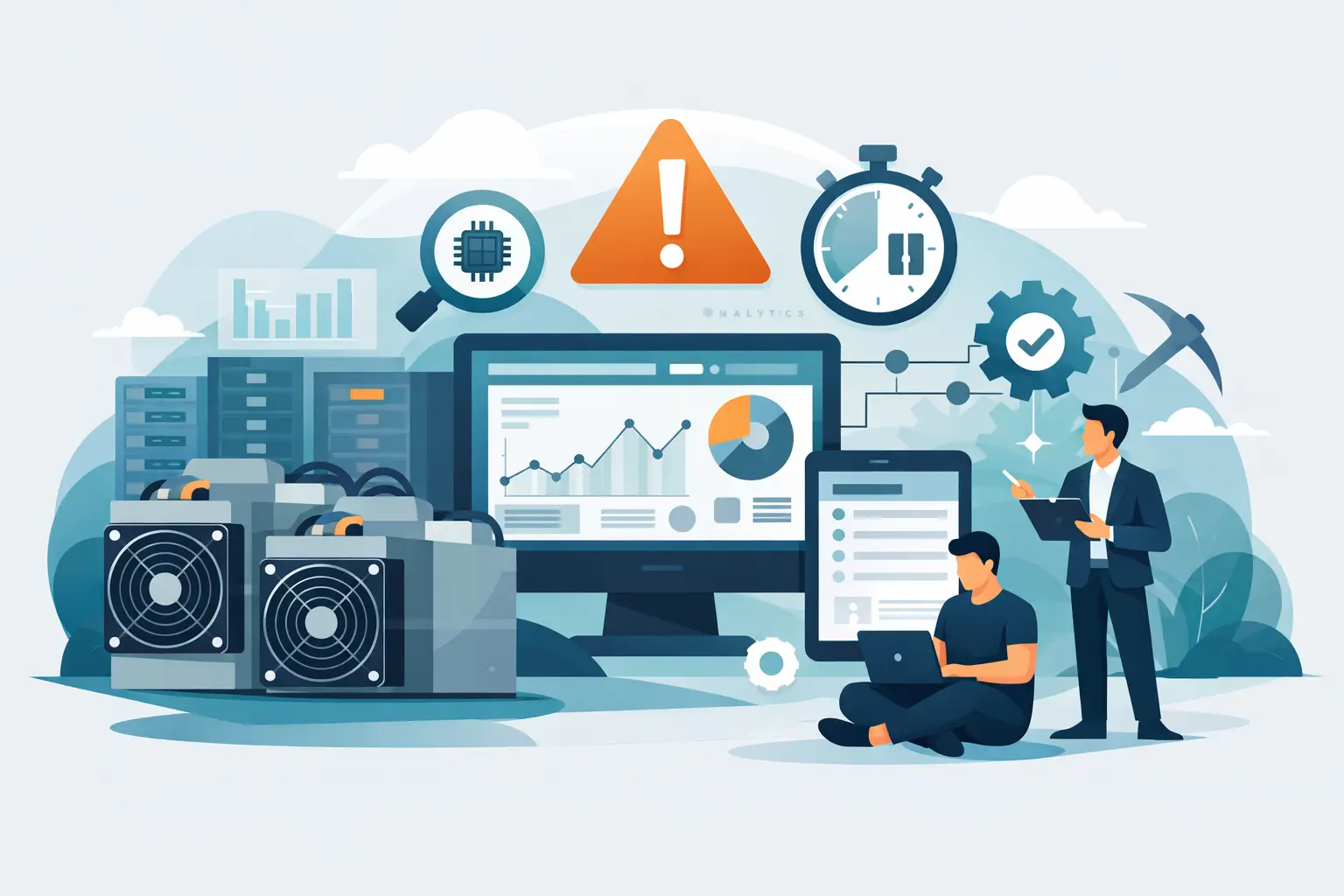
A fleet does not fail all at once. It fails one weak hashboard, one overloaded breaker, one drifting temperature zone, one misconfigured pool worker at a time. Without ASIC fleet monitoring software that connects those signals, operators usually find the problem after the hashrate drop, customer complaint, or electrical trip has already cost money.
A dashboard that only says a miner is offline is not fleet management. It is a late notification. Commercial operators need to move from fleet-level visibility down through the container, rack, machine, hashboard, and individual chip. They need to see what changed, what is at risk, and who owns the next action.
Monitoring Is Only Useful When It Drives Action
A 5,000-machine operation can lose meaningful revenue long before anyone notices a red status indicator. A few underperforming machines may look harmless in aggregate, but they can point to a heat problem, degrading boards from one batch, unstable power, or poor airflow in a specific aisle. The right response depends on the underlying pattern.
That is why passive uptime monitoring falls short. It records symptoms. Production-grade software should help the operations team identify cause, assign work, verify repair, and measure whether the fix held under load.
For a hosting provider, this reaches beyond operations. A miner that is down without a documented cause becomes an SLA dispute. A pool change without a clear audit trail becomes a customer-trust problem. A breaker trip can turn into a billing question, a service credit, and an argument over who was informed first.
The operational chain needs to stay connected: telemetry identifies the fault, automation or an operator contains it, a ticket records the work, and the commercial system reflects the outcome when needed. Fragment that chain across spreadsheets, chat threads, separate monitoring tools, and manual invoices, and the team starts managing ambiguity instead of miners.
What ASIC Fleet Monitoring Software Must See
The fleet view matters, but it is the beginning of investigation, not the end. Operators should be able to sort by hashrate loss, temperature, error state, uptime, efficiency, site, customer, and technician queue. That creates a working priority list instead of a wall of green and red tiles.
Machine-Level Data Finds the Obvious Failures
At the machine level, live hashrate, fan behavior, inlet and outlet temperatures, power state, rejection rate, and worker status answer the immediate questions. Is the miner actually down? Is it hashing below target? Is it too hot? Is it connected to the expected pool and wallet?
Remote access is critical here. Sending a technician to power-cycle a machine that can be recovered through a controlled remote command wastes labor and delays real repairs. But remote control needs guardrails. An operations lead should know who sent the command, when it was sent, and whether the miner recovered afterward.
Pool integrity deserves the same attention as hardware health. A machine can appear healthy while directing hashpower to the wrong worker or wallet. Whether caused by a provisioning mistake, bad configuration, or unauthorized change, it is still a revenue incident. Monitoring should flag the mismatch quickly and give authorized staff a direct path to correct it.
Board and Chip Data Separates Repair From Guesswork
A miner can be online and still be a problem. One degraded hashboard can cut output, increase error rates, and raise thermal stress on the remaining components. If the only available signal is total hashrate, technicians are forced to diagnose from the outside in.
Board-level and chip-level telemetry changes that. It lets the team identify weak chains, abnormal chip readings, frequency instability, temperature spread, and recurring failure signatures before the miner becomes a complete outage. The practical result is better triage: pull the machines most likely to fail, prioritize repairs by lost revenue, and stop replacing parts based on assumptions.
There is a trade-off. More detailed telemetry produces more data, and raw data can bury a small team. The answer is not less visibility. It is better thresholds, clear fleet filters, and alert rules tied to an operational decision. If an alert does not tell someone what to check or what action to take, it becomes noise.
Electrical Visibility Prevents the Expensive Kind of Outage
ASIC operators do not manage only machines. They manage electrical headroom. A miner may be perfectly healthy while the breaker feeding its row is approaching a dangerous load condition. By the time a breaker trips, the incident can take out dozens or hundreds of machines and create a restart sequence that is anything but instant.
Live breaker load monitoring gives electrical and operations teams the same shared picture. They can identify abnormal draw, compare utilization across circuits, and rebalance load before a protection event forces the issue. This is especially valuable when a site adds machines, changes firmware profiles, or operates through seasonal temperature shifts that alter cooling demand and fan power.
Electrical monitoring is not a substitute for competent site design or licensed electrical work. It is the operational layer that catches change in real time. Capacity plans are static. Live amperage is not.
Build a Response System, Not an Alert System
The best operations teams do not rely on someone seeing every notification. They define what happens after a known event. When a miner crosses a thermal threshold, the system can create a maintenance ticket, classify severity, notify the right technician, and preserve the diagnostic evidence. When a worker deviates from the approved pool configuration, it can trigger an immediate control path.
Automated workflows should be specific enough to reduce repetitive work without becoming reckless. A recoverable communication failure may justify an automated reboot. A recurring board fault may require a ticket and a hold for inspection. A breaker risk condition may require staged shutdown rules, escalation to the electrical lead, and a documented recovery sequence.
This is where many monitoring stacks break down. They generate alerts but leave the human team to decide priority, find context, open a ticket, update the customer, and remember the follow-up. That process does not scale from 50 miners to 50,000.
MinersMe Cloud is built around this production reality: fleet telemetry, board and chip diagnostics, breaker visibility, remote controls, pool safeguards, maintenance workflows, billing, and SLA operations in one console. The point is not to collect more charts. The point is to shorten the distance between fault detection and verified recovery.
Choose Metrics That Protect Revenue
Uptime alone is too blunt for a commercial mining operation. A machine can be technically online while hashing under target, producing high rejects, overheating, or mining to an unapproved worker. Teams need a broader operating scorecard that reflects the conditions that actually affect settlement and customer outcomes.
Track expected versus actual hashrate by site, container, customer, and machine model. Watch thermal trends and board error patterns, not only current temperatures. Monitor breaker utilization and repeat trip events. Measure mean time to acknowledge, mean time to repair, repeat repair rate, and the value of hashrate recovered through intervention.
For hosting businesses, tie these metrics to customer-facing records. When a client asks why revenue fell, the answer should not require a week of exporting logs and reconstructing chat messages. It should show the incident window, affected units, cause, actions taken, and any applicable SLA treatment.
There is no universal threshold for every farm. A high-density immersion site, an air-cooled container in West Texas, and a distributed hosting operation will have different thermal and electrical baselines. Good software lets operators tune thresholds by site and equipment class while keeping a consistent operational standard across the company.
The Real Test Is the 3 A.M. Incident
Any platform can look organized during a normal shift. The real test is a hot row, falling hashrate, a loaded breaker, and a customer demanding answers while the on-call technician is working from a phone. Can the team see scope immediately? Can it isolate the issue without taking down healthy machines? Can it prove what happened after the recovery?
That is the standard for ASIC fleet monitoring software. It should turn a noisy mining operation into a controlled one, where every alarm has context, every repair has ownership, and every lost terahash has a path back to work.
Start with the failure that hurts your operation most often - board degradation, power events, pool drift, or slow maintenance handoffs - then make sure your monitoring system can detect it early and drive the next action without a spreadsheet, a scavenger hunt, or a guess.
See it on your own fleet: create a free account, install the agent, or open the live demo — full fleet-to-chip monitoring is included in Pro at $0.40/miner.