 MinersMe Cloud
← Blog · Guides & insights · July 19, 2026
Bitcoin Mining Farm Monitoring That Stops Downtime
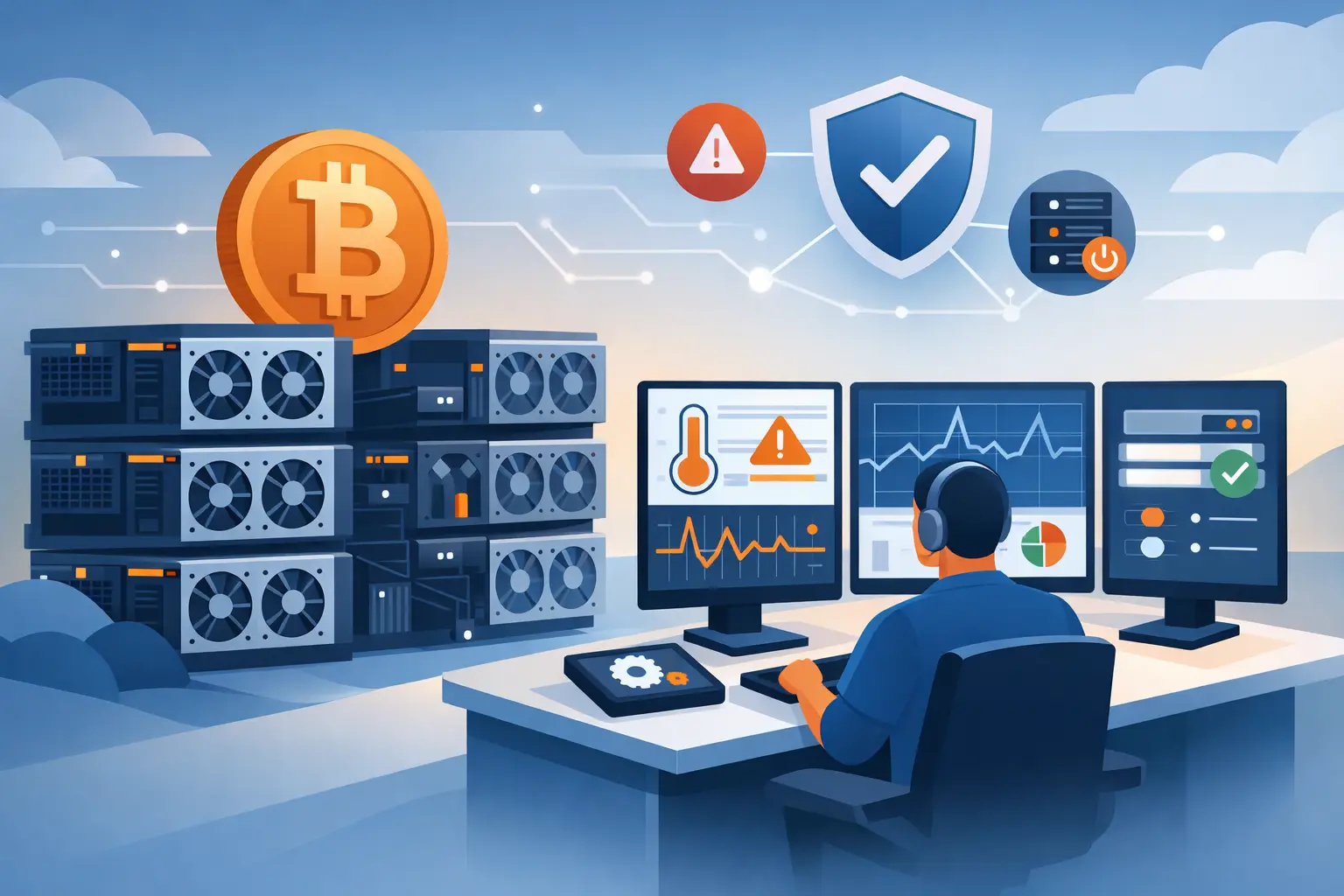
A breaker is running hot in Hall 3. Three miners have already dropped offline, inlet temperatures are climbing across the row, and one customer has opened a ticket asking why their hashrate fell. If your team finds out through a pool report, a group chat, or an angry hosting client, the outage has already cost more than it needed to.
Bitcoin mining farm monitoring is not a dashboard full of green dots. It is the operating system that tells your team what failed, what will fail next, who is exposed, and what action needs to happen before lost hash becomes a settlement dispute.
For a small site, a technician can sometimes carry the operation through attention and instinct. At 500, 5,000, or 100,000 ASICs across multiple locations, instinct becomes a bottleneck. The farm needs telemetry that descends from fleet-wide conditions to the exact miner, hashboard, and chip causing the problem.
What Bitcoin Mining Farm Monitoring Must See
A monitoring stack that only reports online and offline status is too shallow for commercial operations. A miner can be technically online while underperforming, overheating, hashing to the wrong pool, pulling abnormal power, or degrading toward a full board failure. By the time it goes red, the maintenance window may be gone.
Operators need to view the fleet at several levels at once. At the fleet level, the question is whether actual hashrate, uptime, energy use, and worker distribution match the plan. At the site and container level, the question shifts to electrical load, thermal patterns, networking, and localized failure clusters. At the machine level, the team needs fault codes, fan behavior, temperature, hashrate, and reachability. Then comes the diagnostic layer: board health, chip counts, chip temperatures, voltage behavior, and the progression of individual failures.
That depth changes the response. Instead of sending a technician to reboot every machine in a row, you isolate the miners with a degrading hashboard, check whether they share a power path or thermal condition, and create work that has a clear reason behind it.
The Signals That Actually Protect Uptime
Every farm collects data. The difference is whether the data produces a decision while there is still time to act. The core signals are connected, not treated as separate screens:
- Live hashrate versus expected hashrate, including the gap by customer, site, container, and model
- Board- and chip-level health, so partial failures do not hide behind an “online” status
- Inlet and chip temperatures, fan performance, and thermal trends that precede shutdowns
- Breaker amperage and load distribution, especially where a hot circuit can become a facility event
- Pool worker, wallet, and configuration integrity, because a healthy ASIC mining to the wrong destination is still lost revenue
- Ticket status, repair history, and time-to-resolution, so known failures do not disappear into chat threads
The useful question is not whether a value crossed a fixed threshold. It is whether behavior changed in a way that creates operational risk. A board that loses one chip may not require an emergency pull. A board that loses chips over several shifts while temperatures rise and hash falls needs attention before it becomes a dead miner sitting in a rack.
Thresholds still matter. They are necessary for clear alerts around overloads, extreme temperature, offline machines, and pool drift. But trend detection is what gives a maintenance team room to schedule work instead of constantly reacting to alarms.
Start With Electrical Risk, Not Just Miner Status
ASICs do not fail in a vacuum. They sit behind PDUs, breakers, transformers, cooling systems, switches, and power contracts that all have limits. A fleet view that ignores the electrical path can turn a localized miner issue into an avoidable trip.
Breaker load monitoring gives electrical leads a live view of where capacity is being consumed and where imbalance is growing. That matters during deployment, after curtailment recovery, and whenever firmware settings or ambient conditions change power draw. A breaker sitting near its limit can look stable until heat, load variation, or a restart wave pushes it over.
The right response depends on the facility. Some operators need automated load shedding rules that protect the circuit first. Others need an alert that routes directly to the site lead because the power configuration is intentionally tight. The system should support both. What it cannot do is leave breaker data in a spreadsheet updated after the fact.
Thermal monitoring belongs in the same operational view. If a row runs hotter than adjacent rows, the answer may be clogged filtration, fan degradation, restricted airflow, a failed exhaust component, or uneven miner power settings. The dashboard should make the pattern obvious before technicians start swapping healthy units.
From Alerts to Work Orders
An alert without ownership is noise. A fleet can generate thousands of events, and no operations team wins by having a human acknowledge each one. The point of monitoring is to turn the right events into repeatable action.
That means linking a fault to a ticket, a location, a technician queue, a repair category, and a record of what happened next. When a machine goes offline, the workflow may be as simple as a remote recovery attempt followed by escalation. When board degradation appears, the work order should include the machine identity, rack position, board symptoms, prior repair history, and the reason it was prioritized.
Automation should handle the repetitive first moves: detect the condition, attempt approved recovery, open or update the ticket, notify the responsible team, and preserve evidence. Humans should decide the exceptions, such as whether to pull a marginal machine during a high-revenue window or wait for a planned service round.
This distinction matters for hosting providers. A customer does not need a vague message that their miner is “being checked.” They need a traceable explanation of the event, the response, the downtime window, and whether an SLA credit applies. Monitoring data becomes the shared operational record instead of a negotiation based on screenshots.
Protect the Pool Side of the Revenue Chain
A miner can have perfect temperatures and still produce zero value for its owner. Incorrect pool URLs, unauthorized worker changes, misrouted hashrate, wallet substitution, and configuration drift are operational incidents, not minor settings errors.
Pool controls should be monitored alongside hardware health. Compare expected workers and destinations against what the fleet is actually doing. Flag unauthorized changes immediately. Track hashrate at the pool and at the miner so the team can distinguish a local machine issue from a pool-side reporting delay or network problem.
For managed operations, this is also a trust issue. Clients are paying for power, hosting, and machine management. They expect their fleet to hash where it was contracted to hash. A system that detects worker or wallet anomalies protects revenue and removes ambiguity when questions arise.
Build One Operating Picture Across Teams
Farm managers, electrical leads, technicians, finance teams, and client-success staff do not need identical screens. They do need the same underlying facts. Fragmented tools create conflicting versions of the outage: one team sees offline miners, another sees a breaker event, another sees unpaid invoices, and the customer sees missing hashrate.
A production monitoring platform connects those facts. It can show a fleet manager a site-level hash loss, show the technician the failed board, show the electrical lead the load condition, and show the account team the affected customer and SLA exposure. That is how an operation stays fast as it grows.
MinersMe Cloud is built around that operating reality: live fleet telemetry, board and chip diagnostics, breaker load visibility, remote access, pool controls, automated maintenance workflows, and commercial operations in one console. The practical advantage is not having more dashboards. It is removing the gap between detection, diagnosis, repair, and customer accountability.
Measure Whether Monitoring Is Working
Do not judge a monitoring system by how many alerts it sends. Judge it by whether the operation is losing fewer hash hours and resolving incidents with less manual coordination.
Track the time from fault detection to action, the time from action to recovery, repeat failure rates by model and board type, unresolved ticket age, breaker-related events, and the difference between expected and realized hashrate. For hosts, also track how quickly an incident can be explained to a client with evidence rather than estimates.
The trade-off is alert sensitivity. Set it too aggressively and technicians learn to ignore the system. Set it too loosely and early warning becomes a postmortem. Tune alerting by machine model, site conditions, staffing coverage, and the cost of downtime at that location. A high-density facility with limited on-site staff needs different rules than a smaller, fully staffed operation.
The best farm monitoring does not make operations feel quieter because it hides failures. It makes the team faster because every failure arrives with context, ownership, and a path to resolution. When the next board begins to degrade or the next breaker starts carrying too much load, your operators should be acting before the customer has a reason to ask.
See it on your own fleet: create a free account, install the agent, or open the live demo — full fleet-to-chip monitoring is included in Pro at $0.40/miner.