 MinersMe Cloud
← Blog · Guides & insights · August 16, 2026
How to Calibrate ASIC Cooling for Stable Hashrate
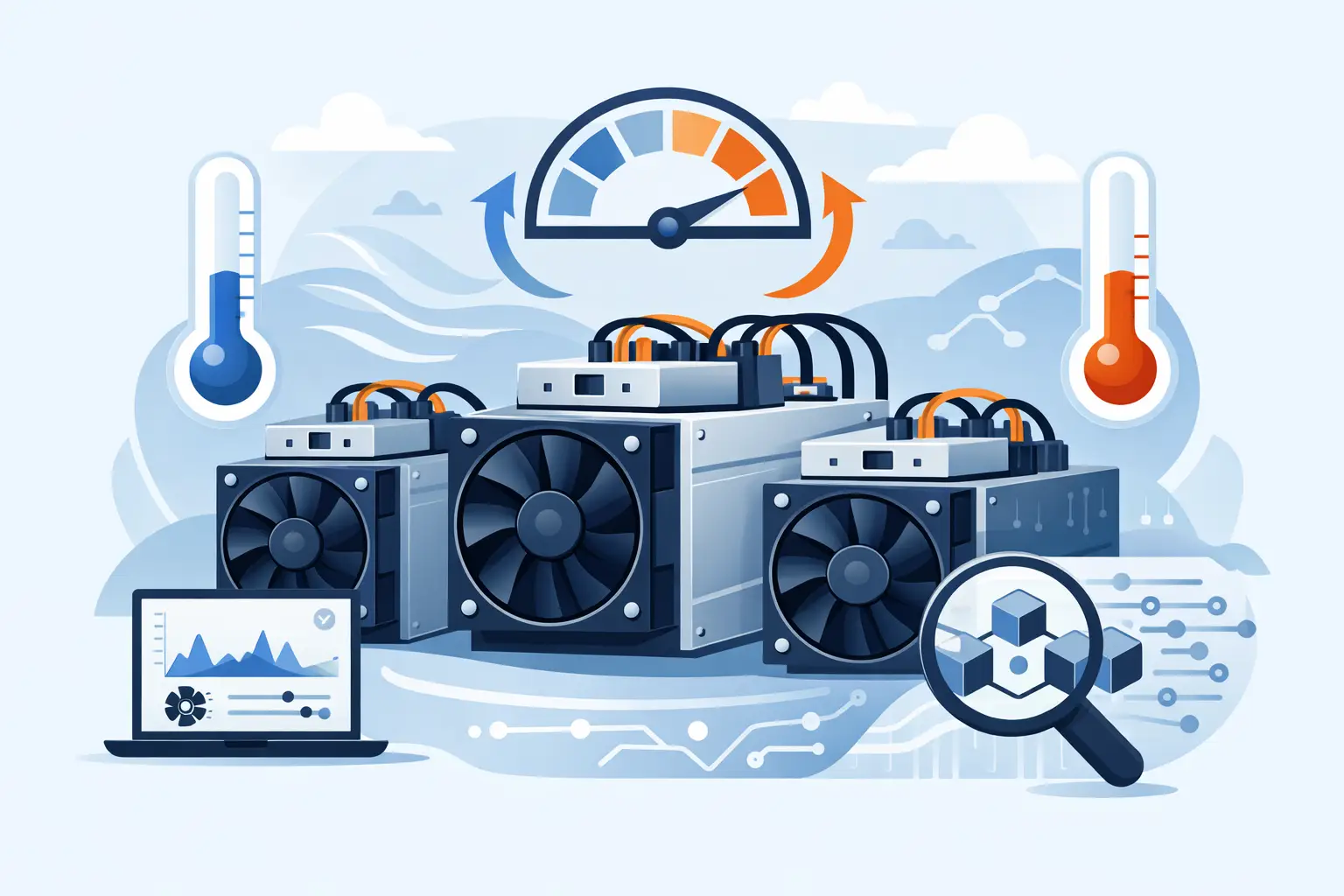
A miner that runs hot is not just uncomfortable hardware. It is a margin leak that turns into board faults, fan failures, underclocking, and eventually a ticket queue full of machines that should have stayed online. Knowing how to calibrate ASIC cooling means setting a repeatable thermal operating range for the room, the rack, and the miner - then proving it holds when the site is under real load.
Cooling calibration is not one fan-speed setting. It is the relationship between intake temperature, exhaust restriction, fan response, chip temperature spread, power draw, and hashrate stability. Get that relationship right and the fleet holds performance through a hot afternoon. Get it wrong and a single blocked aisle can start taking down boards before anyone sees the alarm.
Start with a thermal baseline, not fan speed
Do not begin by forcing fans to 100%. That can mask an airflow problem, consume fan life, increase noise, and still leave the hottest chips operating outside a safe range. Start with a baseline from miners that are known to be healthy and operating at their intended power profile.
Record the intake air temperature at the machine, exhaust temperature, fan RPM, individual board temperatures, chip-temperature range where firmware exposes it, hashrate, error rate, and power draw. Pull this data during a stable operating window, not five minutes after startup or while the room is recovering from a breaker event.
The goal is to establish what normal looks like for each miner model, firmware profile, and cooling design. A S19 running stock air cooling does not share the same thermal behavior as an immersion unit or a hydro-cooled S21. Even miners of the same model can behave differently when one row has recirculated exhaust air or a partially restricted intake path.
A useful baseline is not an average that hides weak machines. Track the spread. If most boards are operating within a narrow temperature band but one board is consistently 8-12°C hotter, that is a machine-level problem waiting to become a board-level failure.
Verify the physical cooling path first
Firmware cannot compensate for bad air. Before tuning targets, inspect the path that air or coolant must travel through the operation.
For air-cooled ASICs, confirm that cold air reaches the intake side and exhaust air has a clear exit route. Separate hot and cold aisles wherever the facility allows it. Check that containment doors, blanking panels, louvers, filters, and fan walls are doing the job they were installed to do. A missing panel can create a recirculation lane that raises inlet temperature for an entire rack.
At the machine level, look for clogged heat sinks, damaged fan blades, loose shrouds, bent chassis panels, blocked intakes, and cable bundles pushed into the exhaust path. Dust buildup is not cosmetic. It reduces heat transfer and increases the static pressure fans must overcome. A miner can show acceptable average temperature while a restricted heat sink pushes a small group of chips into repeated thermal stress.
For hydro and immersion deployments, the same rule applies: verify the physical system before changing software settings. Confirm coolant flow, pump performance, supply and return temperatures, manifold balance, hose condition, filter differential pressure, and heat-exchanger capacity. A low-flow loop is not fixed by lowering a temperature threshold.
Check the room under production load
Cooling systems often look fine during partial occupancy. The failure appears when every container is loaded, the outside temperature rises, and exhaust air has nowhere to go.
Run a full-load validation during the warmest representative conditions you can safely test. Measure intake temperatures at the top, middle, and bottom of racks, and at the first and last positions in each row. Large variations point to airflow distribution problems, not random miner behavior.
Also compare temperature behavior with electrical behavior. If a row begins to run hot after a fan wall ramps up, confirm that the added fan load is not creating a phase imbalance, overloaded circuit, or voltage sag. Cooling and electrical capacity are coupled. A thermal fix that trips breakers is not a fix.
How to calibrate ASIC cooling thresholds and fan behavior
Once the room and machine paths are clean, set operating thresholds around the hardware's safe envelope and the site’s actual thermal capacity. Use manufacturer guidance and your firmware’s supported limits as the ceiling, then create lower operational warning thresholds that give technicians time to act before the miner protects itself.
A practical calibration uses three levels. The first is a warning threshold for rising board or chip temperatures. The second is an intervention threshold that triggers fan escalation, power reduction, or a maintenance workflow. The third is a hard protective threshold where the miner shuts down or is removed from load to prevent damage.
Do not set all alerts at the same number. If your first alert arrives at the same point as thermal shutdown, you have built a notification system, not an operating system. The warning band should expose degradation early: a blocked intake, slowing fan, weak pump, failed containment panel, or a board that is drawing abnormal heat.
Fan control needs the same discipline. A fan curve should increase airflow before temperatures become unstable, but it should not hunt constantly between RPM states. Rapid cycling wears fans and makes diagnostic data noisy. Use a stable target range with enough hysteresis that fan speeds do not jump up and down every time intake air moves by a degree.
For fixed-frequency fleets, validate cooling at the expected power draw. For autotuning or overclocked fleets, calibrate against the highest authorized power profile, not the nominal setting. A machine that is stable at 3,000W may fail at 3,500W with the same room conditions. If the business runs multiple profiles based on power price, define thermal limits and cooling behavior for each profile.
Test one change at a time
The fastest way to lose the root cause is to change fan settings, power limits, room setpoints, and firmware at once. Make one controlled adjustment, observe it across enough miners to avoid a false read, then compare the new telemetry with the baseline.
Watch for more than average temperature. The signals that matter are board-to-board spread, chip-level outliers, fan RPM deviation, hardware-error rate, rejected shares, hashrate variance, and power efficiency. A lower reported temperature is not a win if the miner is throttling, consuming excessive fan power, or producing a rising error count.
A disciplined test should answer a direct operational question: did the adjustment reduce the hottest-board temperature without harming hashrate, efficiency, or electrical stability? If the answer is unclear, revert the change and inspect the physical conditions again.
Turn cooling telemetry into maintenance action
A fleet does not need more temperature graphs. It needs rules that convert thermal drift into action before a machine drops offline.
Set alerts for a single fan running materially below its peers, an increasing temperature gap between hashboards, repeated thermal recoveries, rising inlet temperature by rack, and a cluster of miners that throttle in the same aisle. These patterns distinguish a failing miner from a facility problem. Ten hot miners spread across the site may be ten maintenance cases. Ten hot miners in one row are usually an airflow, containment, or distribution problem.
This is where a unified operating console matters. MinersMe Cloud can correlate miner and board telemetry with breaker load, maintenance tickets, and fleet status, so an operator can see whether a hot group is tied to a bad fan, an overloaded zone, or a site-level cooling failure. The point is not to admire the data. The point is to dispatch the right work before customer hashrate and SLA credits start moving in the wrong direction.
Document the final settings by site, container, miner model, firmware version, and power profile. A calibration that lives in one technician’s memory will disappear during the next shift change. Record the baseline ranges, thresholds, approved fan behavior, and escalation path so the team can detect drift rather than re-argue what normal means.
The right cooling calibration gives your technicians a clear line between normal heat and a pending failure. Keep measuring from the room down to the chip, and act on the trend while the miner is still hashing.
See it on your own fleet: create a free account, install the agent, or open the live demo — full fleet-to-chip monitoring is included in Pro at $0.40/miner.