 MinersMe Cloud
← Blog · Guides & insights · July 22, 2026
Mining Breaker Load Monitoring That Prevents Trips
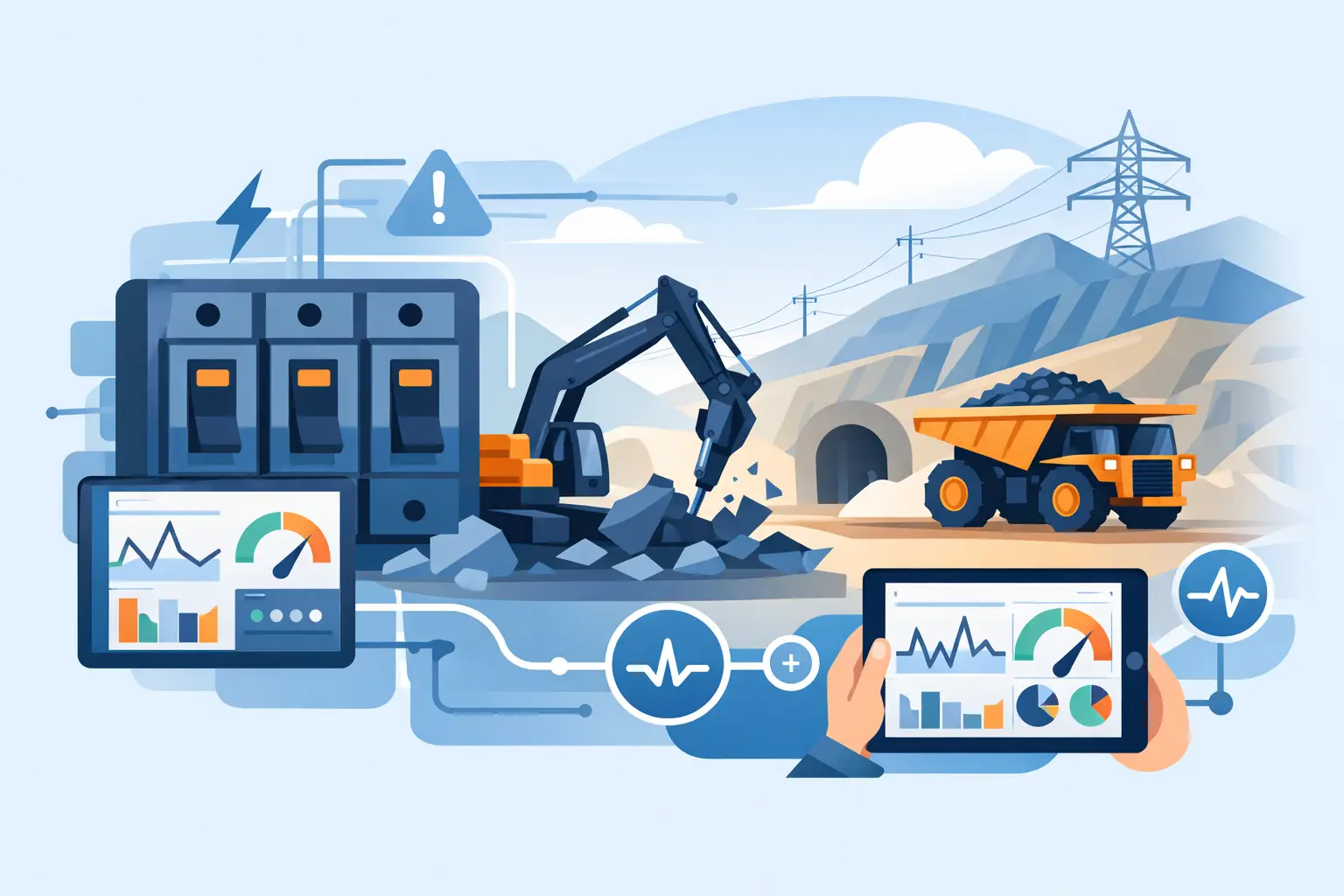
A breaker rarely trips at a convenient time. It trips after a hot aisle has already pushed current upward, after technicians have moved miners between rows, or when a single circuit quietly carries more load than the panel schedule says it should. Mining breaker load monitoring turns that blind spot into a live operating signal: which breaker is loaded, how close it is to its limit, what miners sit behind it, and what action prevents the outage.
For a commercial mining operation, breaker telemetry is not a facilities nice-to-have. A tripped circuit can take dozens of machines offline at once, create recovery work for technicians, distort customer uptime reporting, and leave operators guessing whether the root cause was load distribution, heat, a failing connection, or equipment added without being documented. The cost is not just lost hashprice during the outage. It is the time spent finding the fault, restoring service safely, and explaining it afterward.
Why mining breaker load monitoring belongs in operations
ASICs are predictable loads until the facility is not. A fleet may run close to a steady-state draw, but real sites change constantly. Firmware profiles change. Fans ramp under heat. Machines are swapped. Containers are expanded. A technician plugs a repaired unit into the nearest open outlet because the assigned position is occupied. Small deviations stack up until a branch circuit crosses its safe operating margin.
Panel labels and spreadsheets cannot keep pace with that reality. They show intended design, not live electrical behavior. Even a well-maintained spreadsheet is stale the moment machines move, power modes change, or a breaker starts carrying a different set of loads.
Live amperage closes the gap between the electrical plan and the production floor. At fleet level, an operator needs to see where capacity is tight. At the panel and breaker level, the question becomes more urgent: is this circuit operating normally, trending upward, or one heat event away from a trip? From there, the system must connect the electrical condition to the exact miners, racks, and customers affected.
That descent matters. A red breaker indicator without asset context creates another manual investigation. A breaker alert tied to its miners, their hash rate, thermal state, and maintenance history gives the operations team a decision.
The data that makes breaker monitoring useful
A meaningful breaker view starts with live current measurement, usually sourced from metered PDUs, intelligent breakers, current transformers, or panel monitoring hardware. But raw amperage alone is not enough. Operators need context around the measurement and a baseline that reflects the site’s electrical design.
For each circuit, track rated capacity, configured operating threshold, live current, recent peaks, and load trend. On three-phase infrastructure, visibility by phase is essential. A circuit can appear acceptable in aggregate while one phase is carrying an unsafe share of the load. Phase imbalance increases stress and can turn an apparently healthy row into an intermittent outage problem.
The platform should also map the electrical hierarchy: site, transformer or switchgear path, panel, breaker, PDU, rack, and miner. When that relationship is accurate, a breaker alarm answers practical questions immediately. How much hash rate is exposed? Which hosting accounts are behind the circuit? Can load be shifted to another row? Are the affected machines already showing high temperatures or abnormal power behavior?
Sampling frequency is a trade-off. Wide intervals may be enough for monthly capacity reporting, but they hide short-duration spikes and delay response. Very high-frequency collection produces more data and can create noise if alerts are not designed well. For most operating teams, the useful target is telemetry frequent enough to show change quickly, paired with trend views that distinguish a real rise in load from a brief measurement fluctuation.
Thresholds also require discipline. A breaker’s nameplate rating is not the same thing as its preferred continuous operating limit. Local electrical code, breaker type, conductor rating, ambient temperature, panel condition, and site engineering rules all matter. The monitoring system should support the operating threshold your electrical authority has approved, not impose a generic number that ignores the installation.
Alert before the breaker makes the decision
The best alert is not “breaker tripped.” By then, the production loss has already occurred. The objective is to identify rising risk while the load can still be managed.
A practical alert model uses stages. An early warning flags a circuit that is approaching its defined operating margin. A critical event indicates that immediate load reduction or field verification is required. A trip or communications-loss condition triggers incident handling because the affected miners may already be offline. Those events should be tied to escalation rules, not buried in a stream of generic notifications.
Alert quality depends on correlation. If breaker current rises at the same time that a group of miners shifts to a higher power profile, the likely cause is clear. If current rises while machine count remains unchanged and thermal telemetry is worsening, investigate cooling, fan behavior, connections, or a measurement issue. If a breaker is overloaded while nearby circuits sit well below target, the problem may be load distribution rather than total facility capacity.
This is where isolated dashboards fail. Electrical alerts that do not know what is happening at the machine level force teams into chat threads, screenshots, and manual cross-checks. An operating console should connect a breaker event to worker status, actual hash rate, board health, temperature, power mode, and ticket history. The technician should arrive with a likely fault path, not a vague instruction to inspect a row.
Build response rules around real operating choices
Not every high-load condition deserves the same automated response. A site with spare capacity in adjacent circuits may redistribute machines. A packed container may need a controlled power reduction. A hosting operator may need to protect contractual uptime for one customer before restarting lower-priority equipment. The correct response depends on the electrical topology and the commercial commitment behind the machines.
A useful operating runbook should define who receives the alert, how quickly they respond, what can be changed remotely, and when a technician must inspect the field hardware. It should also record the action. If a breaker ran hot because miners were moved, the asset map must be corrected as part of the resolution. Otherwise, the same bad data will create the next outage.
Remote controls can reduce exposure, but automation needs guardrails. Automatically shutting down selected miners may prevent a breaker trip, yet it can also cut customer revenue if the logic chooses the wrong machines. The right policy might stop units with existing board faults, low efficiency, or lower contractual priority first. In other sites, only an operator should approve a shutdown because circuit mappings are still being validated.
That is the operational trade-off: faster intervention versus the risk of acting on incomplete data. Start with alerts and operator-guided workflows. Add controlled automation once breaker-to-miner mapping, telemetry quality, and escalation ownership have proven reliable.
Use breaker history to find capacity that is actually usable
Breaker monitoring is not only an incident tool. Over time, it becomes a capacity-planning record. Historical peaks reveal which rows have real headroom, which circuits are consistently near their defined limit, and whether expansion plans are based on measured availability or optimistic panel schedules.
This is particularly valuable when deploying newer ASIC generations. A nameplate wattage calculation may be directionally correct, but it does not replace observing the fleet’s actual behavior across ambient conditions, firmware settings, and operating modes. Compare expected draw with live measurements before filling the remaining positions in a row.
Historical patterns also expose maintenance problems. A breaker whose current profile becomes erratic may point to intermittent loads, failing metering, loose connections, or changes in miner behavior. Current alone does not diagnose a connection fault, and electrical work must remain with qualified personnel. But it tells the team where to look before a minor abnormality becomes a production event.
For hosts, the history supports cleaner customer conversations. When a client disputes downtime or power allocation, operators can review the circuit event, affected machines, outage window, recovery actions, and the resulting hash-rate impact. That is stronger than reconstructing the incident from technician messages after the fact.
Treat the breaker as part of the fleet
A breaker is not just a line item on a one-line diagram. It is a production dependency for every miner behind it. If its load rises, your available hash rate is at risk. If it trips, the incident crosses electrical operations, maintenance, customer service, billing, and SLA reporting within minutes.
MinersMe Cloud brings breaker load, live miner telemetry, board diagnostics, ticket workflows, and customer-facing operating records into the same console. That means the team can move from an overloaded circuit to the specific machines and the action required without assembling the incident across separate tools.
Start by validating circuit mappings, setting thresholds approved for the actual installation, and watching trends before relying on automation. Once the data matches the floor, breaker load becomes one of the clearest early warnings a mining operation can have - enough time to move load, dispatch the right technician, and keep an electrical warning from becoming a hall-wide outage.
See it on your own fleet: create a free account, install the agent, or open the live demo — full fleet-to-chip monitoring is included in Pro at $0.40/miner.