 MinersMe Cloud
← Blog · Guides & insights · August 26, 2026
Miner Telemetry Tools Comparison for ASIC Farms
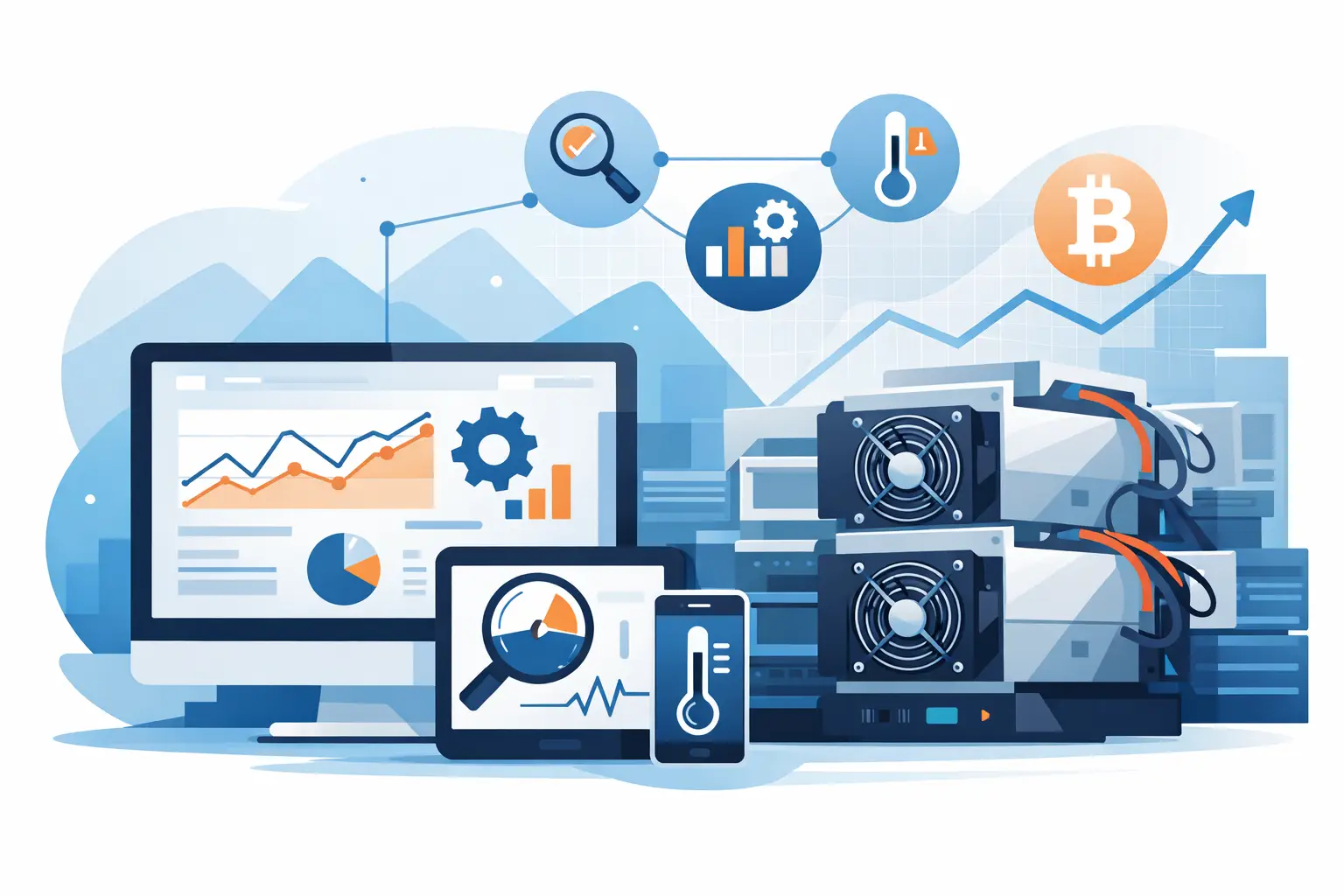
A hall can look healthy at 98% uptime while money is already leaking through degrading hashboards, overloaded breakers, misdirected workers, and tickets nobody owns. That is the real reason a miner telemetry tools comparison matters. The question is not which dashboard has the cleanest charts. The question is whether the system gives your team enough evidence to stop a failure before it becomes lost hash rate, a client dispute, or a site-wide outage.
For commercial ASIC operations, telemetry is only useful when it changes the next action. A red miner count is not an operating system. Neither is a temperature chart that cannot tell a technician which board is degrading, whether the machine is safe to restart, or whether the rack is approaching an electrical limit.
Miner Telemetry Tools Comparison: Start With Failure Depth
Most mining telemetry products fall into three categories. Basic monitors collect miner status and hash rate. Firmware-centered tools add tuning, profiles, and device-level controls. Operations platforms connect device telemetry to electrical conditions, maintenance, pool integrity, customer obligations, and commercial workflows.
Each category has a place. A small owner with a few machines may only need online/offline status and simple alerts. A tuning-heavy operation may prioritize frequency controls and power profiles. But a hosting company responsible for thousands of machines needs to answer a more serious chain of questions: What failed? What caused it? Who is assigned? What is the expected recovery? What revenue exposure exists? Did the fix hold?
That difference separates monitoring from operational control.
Fleet-level views are the starting point, not the diagnosis
Every tool can show hashrate, rejected shares, temperatures, and an offline count. Those are fleet-level symptoms. They help an operations manager see that a site is drifting, but they do not necessarily identify the faulty component.
A useful platform should let the team descend from the fleet to a site, container, rack, miner, hashboard, and chip. At each level, the data should remain tied to a specific action. If a miner is underperforming, technicians need to see board hash rate, chip response, temperature behavior, fan data, error history, voltage indicators, and the conditions surrounding the drop.
Without that depth, a technician reboots the machine, waits, and hopes. With it, the team can isolate a degrading board, identify recurring thermal stress, or pull a unit before it fails hard and consumes more labor.
Compare Telemetry by the Questions It Can Answer
Do not evaluate tools by counting widgets. Run each product against the incidents that cost your operation real money.
Can it distinguish a dead miner from a live miner producing materially less than expected? Can it flag a single weak board before the whole unit drops? Can it identify unstable temperatures over time instead of only reporting the current reading? Can it show whether a decline is isolated to one machine, one rack, one container, or one site condition?
Historical context matters here. A point-in-time reading may look normal after a restart, while the trend shows repeated thermal spikes every afternoon or a board that loses performance in stages. The system should preserve the evidence needed to make a repair decision, not force staff to reconstruct the incident from screenshots and chat messages.
The best telemetry also accounts for the ugly realities of stock firmware fleets. Many operators run mixed generations, mixed vendors, mixed sites, and machines that cannot all be standardized overnight. A tool that only works cleanly after a firmware conversion can create a second project before it solves the first one. Verify device coverage, polling behavior, data accuracy, and controls on the hardware you actually operate.
Electrical visibility is not optional at scale
Miner-level data alone cannot protect a facility. A miner can look fine right up until a breaker trips, a PDU is overloaded, or a cooling issue turns a row into a thermal problem.
Compare whether the platform captures live amperage and breaker load at the electrical layer, and whether that data is visible beside the affected miners. The operational value is direct: your team can see load concentration before protection trips, investigate an abnormal power draw, and avoid treating every hash rate event as a miner problem.
This is especially important in hosting environments, where power limits are contractual and capacity is sold. If electrical readings live in one system and miner health lives in another, the team loses time during the exact event when speed matters. The data must meet in the same incident view.
Alerts Matter Only If They Trigger Ownership
The weakest telemetry tools notify everyone and assign nobody. A flood of Telegram messages, email alerts, and dashboard warnings does not produce uptime. It produces alert fatigue and a maintenance backlog hidden in conversation threads.
Evaluate how alerts become work. A serious system should create or support a maintenance ticket with the affected asset, fault details, priority, owner, status, history, and resolution record. That record gives a farm manager visibility into aging tickets, repeat failures, technician throughput, and parts patterns.
Automation should be judged with the same standard. Restart logic can recover a transient fault, but blind reboot loops can mask a failing board and waste hours. The right workflow uses thresholds, escalation, and evidence. For example, a persistent board-level fault can create a ticket after a defined recovery attempt, while a breaker-load condition can trigger immediate escalation because the risk is broader than one miner.
Ask vendors what happens after an alert fires. If the answer is “your team gets notified,” you are still building the operating process yourself.
Pool and Worker Controls Protect Revenue You Cannot See on the Floor
A fleet can be powered, cool, and online while hashpower is pointed at the wrong pool or worker. That is not a cosmetic configuration issue. It is a revenue control failure.
A credible comparison should include pool configuration visibility, worker integrity, hash rate reconciliation, and the ability to detect unauthorized changes quickly. Operators need to know when actual worker behavior diverges from expected configuration, especially across remote sites and customer-owned machines.
For hosting providers, this also affects trust. Clients do not care that the miner was technically online if their expected hashpower was misrouted or their settlement cannot be explained. Telemetry, pool controls, and reporting should support the same source of truth.
The Commercial Layer Separates a Farm Tool From a Hosting Platform
A pure monitoring tool may be enough for a self-operated mine. It is usually incomplete for a business selling uptime, power, and managed infrastructure to customers.
Hosting operators need asset ownership records, customer views, billing inputs, SLA tracking, credits, and payment workflows tied to what happened in the hall. Otherwise, operations works from telemetry, finance works from spreadsheets, and client success works from a different ticket history. Every disputed invoice becomes a manual investigation.
This is where an all-in-one platform can remove operational drag. MinersMe Cloud combines fleet and chip-level telemetry with electrical monitoring, maintenance workflows, pool controls, billing, SLA credits, and crypto payment capabilities in one console. The value is not a longer feature list. It is being able to trace a client-facing outcome back to the machine, board, breaker, ticket, and recovery timeline that caused it.
Compare the Cost Model Against the Work You Still Have to Do
Do not compare subscription prices without comparing missing capability. A lower per-miner monitoring fee can become expensive when you add separate ticketing, electrical monitoring, pool management, billing, customer reporting, and integration work.
Look for feature gates that appear after deployment: enterprise-only APIs, paid alerting, restricted historical data, extra sites, premium automation, or separate commercial modules. These pricing structures make budget forecasting difficult and can force an operator to choose between visibility and cost control during growth.
An all-inclusive per-miner price is easier to model, but only if the product truly covers the workflows your operation needs. Confirm what is included, how pricing changes across sites, what support looks like during an outage, and whether the system performs under your expected fleet size. A tool that works in a 200-miner demo is not automatically ready for 20,000 miners across multiple locations.
Test Every Tool During a Real Incident Scenario
Before committing, use a controlled evaluation based on failure response. Pick a recent event: a bad hashboard, recurring overheating, a breaker overload risk, a worker configuration issue, or a customer dispute over downtime.
Then ask the vendor to show the exact path from detection to resolution. How quickly does the issue appear? What telemetry explains it? Can the system identify the specific machine and component? Does it create accountable work? Can you see the electrical or pool context? Can you document the recovery for an internal review or an SLA conversation?
If the demonstration stays at a colored fleet map and a generic alert screen, the platform is telling you its limit. Production operations are decided in the details after the first warning.
Choose the telemetry system that lets your team act before the outage becomes visible to your customer. That is where better data turns into protected uptime, fewer truck rolls, and a mining operation that can scale without scaling chaos.
See it on your own fleet: create a free account, install the agent, or open the live demo — full fleet-to-chip monitoring is included in Pro at $0.40/miner.