 MinersMe Cloud
← Blog · Guides & insights · August 22, 2026
Manual Versus Automated Maintenance for ASIC Fleets
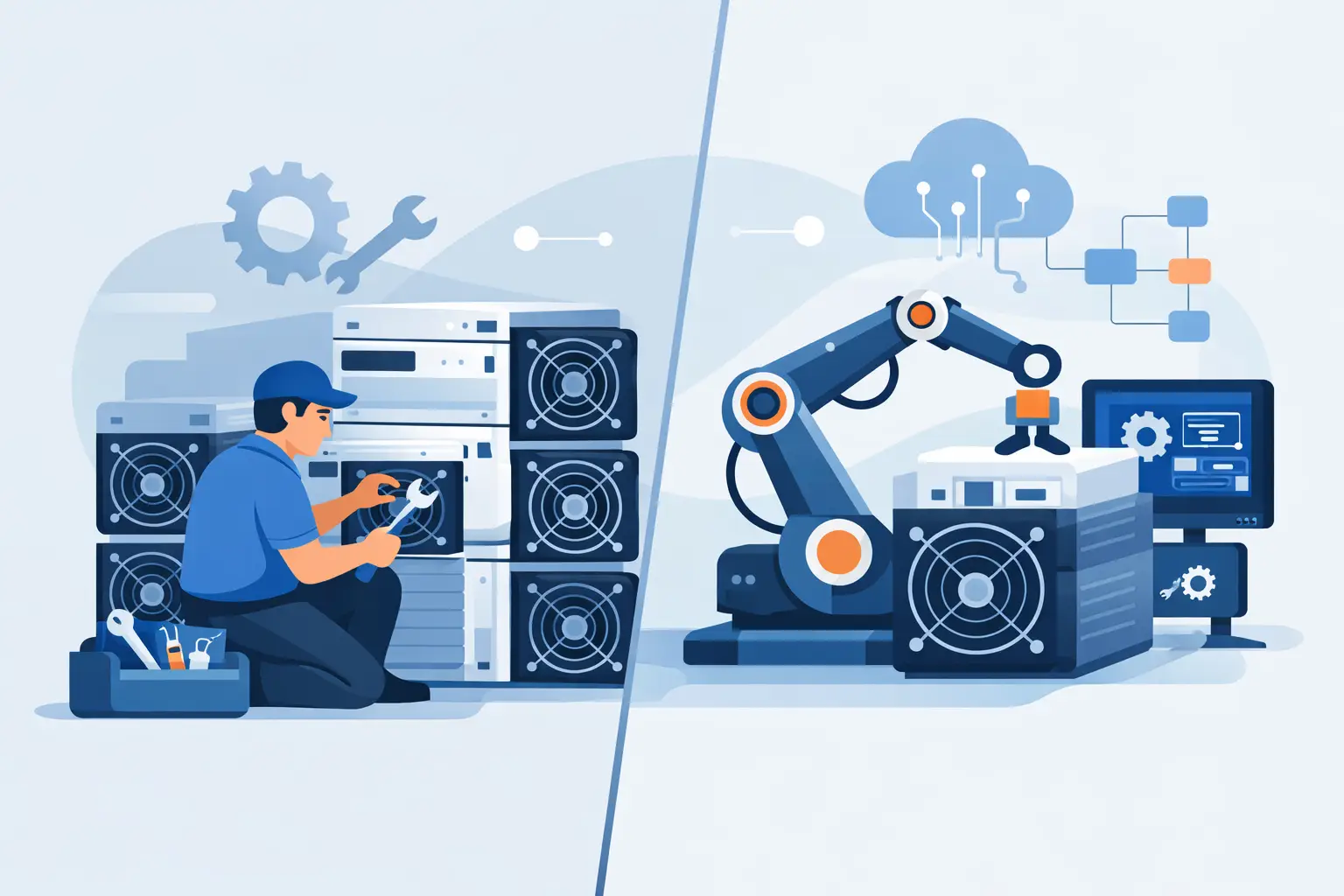
A single S21 reporting weak chips is not a crisis. A single S21 reporting weak chips while the ticket sits in a chat channel for six hours can become one. That is the real argument in manual versus automated maintenance: not whether technicians still matter, but whether your operation sees, prioritizes, and contains failure before hashpower, electrical capacity, and customer trust start leaking.
For a 50-miner site, a sharp operator can keep much of the workflow in their head. At 5,000 machines, memory becomes spreadsheets, screenshots, and shift handoffs. At 50,000, that model does not scale. The fleet will generate more signals, exceptions, and repeat faults than any team can reliably triage by hand.
Manual Versus Automated Maintenance: The Real Difference
Manual maintenance is driven by people observing a problem, deciding what it means, creating a work item, assigning it, and confirming the outcome. It can be disciplined and effective, especially for physical work that requires a technician at the rack. But it is inherently periodic. A person sees what they check, when they check it, and may interpret the same signal differently across shifts.
Automated maintenance uses live telemetry and defined conditions to initiate the first operational response. A machine falls below a hash-rate threshold, a board begins accumulating chip errors, inlet temperatures push beyond a safe operating range, or a breaker load approaches its limit. The system detects the condition, applies the policy, creates or routes the ticket, preserves the evidence, and keeps an audit trail.
The distinction matters because an ASIC fleet does not fail one neat device at a time. It fails through patterns. A row runs hot after a fan issue. Multiple miners on one PDU begin throttling. A firmware setting drifts after replacement. Workers point to the wrong pool. A marginal hashboard keeps cycling between degraded and offline until it finally fails during a high-revenue period.
Manual processes can record these events. Automation can react to them at machine speed.
What Manual Work Still Does Better
Automation is not a substitute for a qualified technician. It cannot reseat a cable, replace a failed fan, clean clogged heat sinks, inspect a burned connector, or decide whether a board belongs in the repair queue or should be retired. It also should not make irreversible decisions from one noisy data point.
Human judgment is strongest at the physical boundary of the operation. A technician can distinguish between a recurring board-level failure and a rack-level power or cooling issue. An experienced electrical lead can recognize that a breaker alert is a load-distribution problem, not a miner problem. A site manager can decide whether to shut down a section during an unstable grid event, even if individual units still appear online.
Manual review also matters when the cost of a false action is high. Automatically rebooting a miner after a confirmed fault may be sensible. Automatically power-cycling an entire container because a few devices report stale telemetry is not. Good automation has guardrails, escalation paths, and an operator who owns the policy.
The mistake is treating those necessary human decisions as a reason to make every decision manual. That is how technicians become alert routers instead of repair specialists.
Where Manual Maintenance Starts Losing Money
The first loss is detection latency. A technician may find an underperforming miner during a scheduled walk-through or after a customer reports a dashboard discrepancy. By then, the machine may have spent hours hashing below target, sending rejected shares, or consuming power without producing expected output.
The second loss is triage quality. A spreadsheet can show that 40 miners are offline. It rarely tells the on-call team whether they share a breaker, a switch, a pool endpoint, a firmware version, a batch, or a thermal zone. Without that context, the team sends people toward individual machines when the actual failure sits upstream.
The third loss is repeat failure. If each technician manually writes a ticket and each shift closes it differently, the operation loses the history required to identify chronic offenders. A miner that has been rebooted three times this month is not simply “back online.” It is a developing maintenance event with a measurable probability of becoming a harder failure.
Then there is the commercial cost. Hosting customers do not care that an outage was difficult to diagnose. They care whether their miners were offline, whether the incident was documented, and whether SLA credits or billing adjustments are accurate. Chat-based maintenance records are not evidence. They are a liability when revenue is disputed.
What Automated Maintenance Should Actually Automate
The goal is not to automate every action. The goal is to automate repetitive detection, classification, routing, and low-risk recovery so people can handle the exceptions that require judgment.
A production system should watch live hash rate, board status, chip-level errors, temperatures, fan behavior, pool connection state, worker configuration, and electrical load. It should correlate those signals across the fleet rather than treating each device as an isolated alert.
When conditions match an approved policy, the system should take the first step without waiting for someone to read a notification. That may mean opening a ticket with the miner serial number, rack location, fault code, recent telemetry, and recommended action. It may mean assigning work by site or technician queue. For narrowly defined cases, it may mean a controlled reboot, pool correction, remote access action, or customer notification.
The ticket is not paperwork after the fact. It is the operational object that connects the fault to the action, the technician, the parts used, the downtime window, and the final resolution. Over time, that history becomes a maintenance dataset: which models fail first, which sites create thermal stress, which repair actions hold, and which “fixed” miners return to the queue.
At MinersMe Cloud, this is the difference between a passive fleet dashboard and an operating console. The platform can connect machine, board, and chip diagnostics with tickets, breaker load monitoring, pool controls, and commercial records in the same workflow. An operator should not need five tools and a detective story to explain why a customer’s unit stopped earning.
Build Policies Around Failure Modes, Not Generic Alerts
The weak version of automation sends more alerts. The useful version defines response policies for known failure modes.
For thermal events, start with trend detection. A miner whose inlet temperature rises with its neighbors may point to airflow, containment, or cooling capacity. A miner whose board temperature diverges from nearby units may need machine-level inspection. Those events deserve different tickets, owners, and urgency.
For electrical risk, treat live amperage as a constraint, not just a chart. A breaker nearing its practical limit can become an outage affecting an entire row. Automated thresholds should escalate before the trip, while operators still have options to redistribute load, reduce clocks, or isolate failing equipment.
For hashboard degradation, avoid waiting for a complete failure. Repeated chip errors, declining board performance, and unstable recovery after reboot are early evidence. Flag the unit, preserve the trend, and schedule service during a controlled window when possible. Planned repair beats emergency repair because it protects both labor and uptime.
For pool integrity, policies should detect workers that drift from approved endpoints, credentials that fail, and miners that are online but not contributing expected shares. This is not merely a configuration nuisance. Misrouted hashpower can become a direct revenue and security incident.
The Trade-Off: Automation Needs Clean Operations
Automated maintenance amplifies whatever process you feed it. If asset records are wrong, tickets will route to the wrong rack. If thresholds are copied blindly, teams will get noise instead of signal. If no one owns closure codes, the fleet will accumulate bad data and false confidence.
Start with a limited set of high-confidence events: offline miners, confirmed board faults, excessive breaker load, pool misconfiguration, and repeat incidents after prior repair. Define who receives the ticket, what evidence is required, which actions are automatic, and when escalation occurs. Review false positives weekly. Tune policies against real downtime, not against how many alerts the dashboard can produce.
The right model is hybrid. Automation watches every miner all the time, catches the pattern, and moves the work into a controlled queue. Technicians inspect, repair, and verify the physical reality. Operations leaders use the resulting data to change thresholds, staffing, spare-part strategy, and site design.
Your technicians should spend their shift fixing failed fans, bad boards, hot rows, and unstable power - not hunting through spreadsheets to determine which alert arrived first. Build the system so the bot handles the repeatable work, and your people get to the fault while it is still small.
See it on your own fleet: create a free account, install the agent, or open the live demo — full fleet-to-chip monitoring is included in Pro at $0.40/miner.