 MinersMe Cloud
← Blog · Guides & insights · July 24, 2026
Automated Maintenance Ticketing Software for ASICs
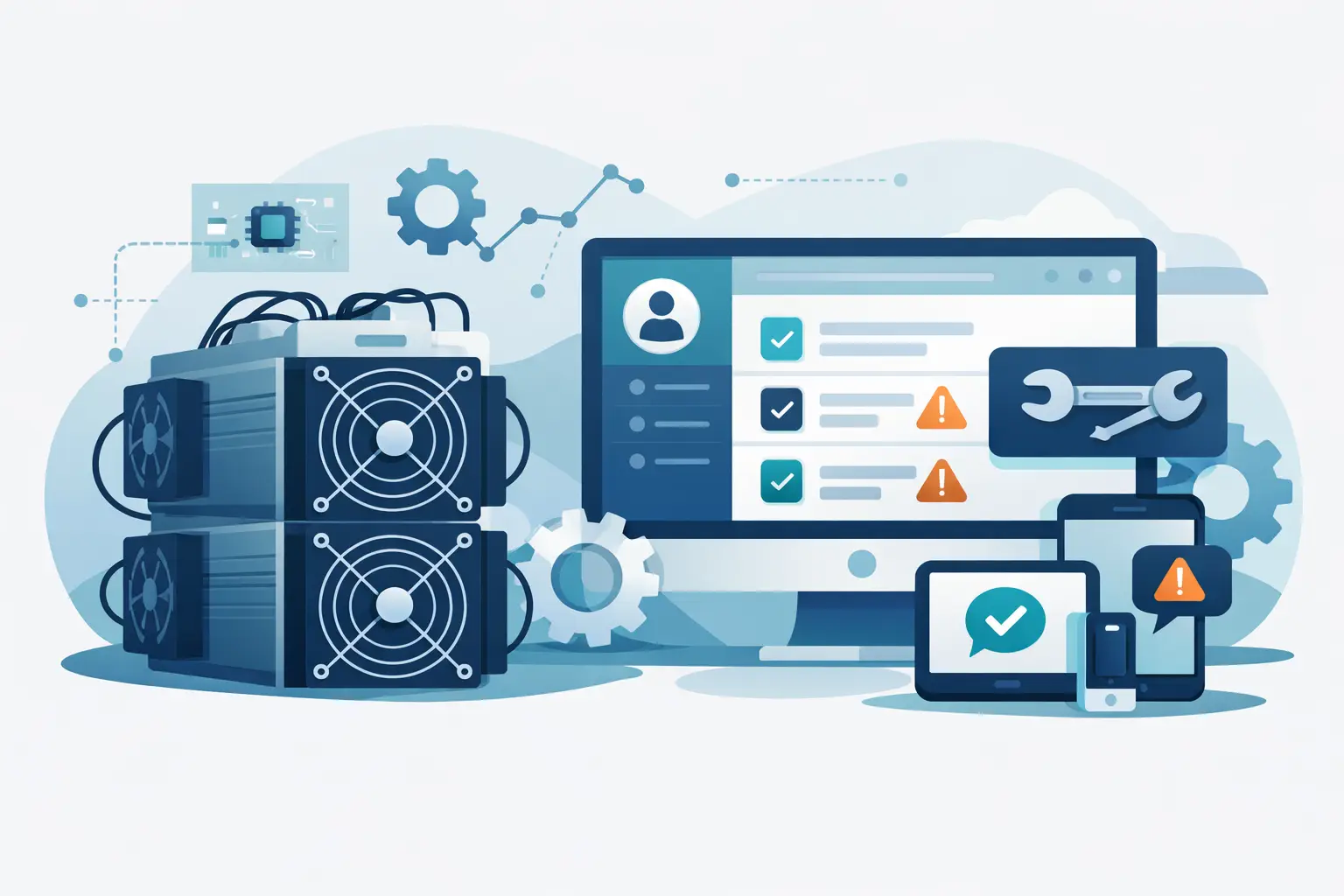
A 3.2 TH/s drop on one miner is easy to ignore. A rack of machines showing the same thermal pattern, rising board errors, and a breaker approaching its load ceiling is an outage forming in plain sight. The difference between a recoverable condition and a revenue event is whether the signal becomes a repair action before technicians start chasing alarms in chat.
Automated maintenance ticketing software gives mining operations that action layer. It turns live machine health, chip and board faults, temperature behavior, power conditions, and pool exceptions into assigned, trackable work. For a farm running hundreds or thousands of ASICs, that is not administrative cleanup. It is how the operation protects uptime, technician capacity, customer trust, and hashprice-sensitive revenue.
Why Mining Maintenance Breaks at Scale
Most farms do not fail because the team lacks a ticketing tool. They fail because the ticketing tool has no idea what is happening inside the fleet.
A generic help desk can record that Miner 4-17 is down. It cannot determine whether the root cause is a failing hashboard, a fan issue, a PSU fault, a pool-side worker configuration change, or a circuit nearing overload. The technician still has to open another dashboard, pull logs, inspect the miner, search a spreadsheet for ownership, and ask in a group chat whether someone already touched it.
That workflow wastes the one resource a busy farm never has enough of: qualified technician time. It also creates a second problem. Management sees a queue of vague tickets, while the actual operational risk is hidden in telemetry. Ten “offline” miners may be a trivial switch issue. One breaker alert may put an entire row at risk.
Maintenance needs to start from the condition that matters, not from a manually written description after the condition has already cost money.
What Automated Maintenance Ticketing Software Must Do
For ASIC operations, automation is not simply creating a ticket whenever a miner goes offline. That creates noise, duplicates, and a maintenance queue nobody trusts. Useful automation needs context, prioritization, and a clear path from detection to closure.
Build tickets from machine-level evidence
A good system watches live operating data and opens maintenance work when a defined failure pattern appears. That might be a hashboard dropping from normal performance, an increasing chip error rate, sustained thermal imbalance, unstable fan RPM, a PSU-related fault, or a miner repeatedly failing to recover after a controlled restart.
The ticket should carry the evidence with it: miner identity, location, owner, current and expected hashrate, board status, temperatures, error logs, timestamps, and recent events. A technician should not need to reconstruct the failure from six separate systems while standing in a hot aisle.
The same principle applies at the electrical layer. If live amperage indicates a breaker is carrying unsafe load, the work item must identify the affected circuit and machines. A generic “power warning” is not operationally useful when a technician needs to know what can be moved, powered down, or inspected before a trip takes out a larger section of the hall.
Separate incident noise from real work
An ASIC may briefly disconnect during a network change, firmware update, or planned power cycle. Opening a repair ticket for every transient alert turns automation into spam.
The rules need persistence and correlation. A miner that misses a few telemetry intervals may warrant an alert. A miner that remains offline after recovery attempts, or repeatedly returns with the same board fault, may warrant a ticket. If 80 miners disappear from the same switch or container at once, the platform should group the event around the likely shared cause instead of creating 80 individual technician assignments.
This is where thresholds matter. Aggressive rules find problems earlier but can overload the queue. Conservative rules reduce noise but can leave degrading equipment running too long. The right setting depends on fleet size, spare inventory, technician coverage, repair turnaround, and the cost of lost hashrate at that site.
Assign work to the people who can close it
A ticket without ownership is an alarm with extra steps. Automated workflows should route work by site, container, customer fleet, failure type, or technician group. A board-level fault goes to the repair workflow. A suspected network issue goes to the infrastructure owner. A breaker condition goes to the electrical lead with the urgency it deserves.
Assignment also needs accountability. The system should show when the issue was detected, when it was acknowledged, who changed status, what repair action was taken, and whether the miner actually returned to expected output. “Closed” is not a meaningful result if the same unit fails again six hours later.
For hosting providers, this history is equally important for client communication. The operator can show that a machine was identified, serviced, tested, and restored, rather than relying on an informal message thread after a customer notices lower hashrate.
The Maintenance Workflow That Holds Up in a Mining Hall
The strongest workflow is simple enough to run during an outage and detailed enough to improve the next one.
First, telemetry detects an actionable condition. Second, the platform evaluates rules, suppresses known maintenance events, and correlates related faults. Third, it creates a ticket with severity based on operational impact. Fourth, the ticket is routed to an owner with diagnostics and location attached. Finally, the repair is verified against live fleet data before the work is closed.
That last step is where many maintenance systems lose the plot. Replacing a fan, reseating a cable, rebooting a machine, or swapping a board is an action, not proof of recovery. Verification should confirm that the miner is online, hashing at the expected level, reporting healthy boards, and pointed to the correct pool and wallet configuration.
A closed ticket should leave behind a usable record: failure type, suspected root cause, parts consumed, labor time, technician notes, and recovery result. Over time, that data exposes repeat offenders. You can see whether a batch of miners is degrading faster than expected, whether a specific container has thermal issues, whether certain repairs do not hold, and where spare parts are actually being consumed.
Prioritize Revenue Risk, Not Ticket Age
The oldest ticket is not always the most important ticket. A low-hashrate unit in a low-priority customer fleet may matter less than a pool integrity issue affecting hundreds of machines. A single offline miner might be routine. A rising load on a breaker feeding a full row requires immediate attention.
Severity needs to reflect the blast radius. Consider expected lost hashrate, number of affected miners, electrical exposure, customer SLA commitments, recurrence, and whether the issue could spread. A suspected worker hijack or incorrect pool destination deserves a different response from one degraded chip on a single machine.
This is also why disconnected ticketing tools become dangerous at scale. If the queue cannot see fleet state, energy conditions, machine ownership, and pool configuration, operators prioritize by incomplete information. They may spend an hour restoring a single unit while a larger revenue leak continues elsewhere.
Where Automation Should Stop
Not every corrective action should be fully automatic. Controlled restarts can be useful for recoverable software faults, but repeated restart loops can hide a failing board, aggravate an unstable circuit, or waste technician time later. Remote commands should operate within limits and leave a clear audit trail.
The same caution applies to ticket closure. Automation can close a ticket after sustained healthy telemetry, but only if the recovery criteria match the failure. A miner that comes online for three minutes is not repaired. For complex electrical faults, recurring board failures, and customer-impacting incidents, human review remains the right control.
Automation should remove repetitive detection, routing, and follow-up. It should not pretend that every physical failure has a software-only fix.
One Operational Record From Fault to Settlement
For hosts and managed operators, maintenance is connected to commercial operations whether the software recognizes it or not. A long outage can trigger SLA review. A customer may challenge billing when machines were unavailable. A repair can require a part charge, a labor record, or a clear explanation of what happened to a specific fleet.
MinersMe Cloud approaches this as one operating system: telemetry identifies the fault, maintenance workflows drive response, and the operational record remains connected to the fleet, customer, and commercial process. That matters when the business operates at scale. A ticket should not disappear into a separate tool just as its consequences reach client success, billing, or settlement.
The all-in-one approach is not always required for a small farm with a few technicians and a single site. A lightweight workflow can be enough when everyone knows every machine. But once teams span sites, shifts, customer fleets, and electrical zones, manual coordination becomes a hidden outage multiplier.
Make the Queue a Control Surface
A maintenance queue should tell the shift lead what can hurt production next, who owns the response, and whether the fix held. If it is merely a list of complaints, technicians will route around it. If it is fed by real ASIC, thermal, electrical, and pool data, it becomes part of the farm's control surface.
Start with the failure modes already costing the operation money: repeat board faults, offline miners that do not recover, thermal drift, breaker risk, and unauthorized pool changes. Build clear rules, demand verification before closure, and review recurring tickets weekly. The goal is not more tickets. The goal is fewer surprises in the next hot aisle, at the next breaker panel, and on the next customer revenue report.
See it on your own fleet: create a free account, install the agent, or open the live demo — full fleet-to-chip monitoring is included in Pro at $0.40/miner.