 MinersMe Cloud
← Blog · Guides & insights · August 30, 2026
ASIC Reliability: Stop Failures Before Downtime
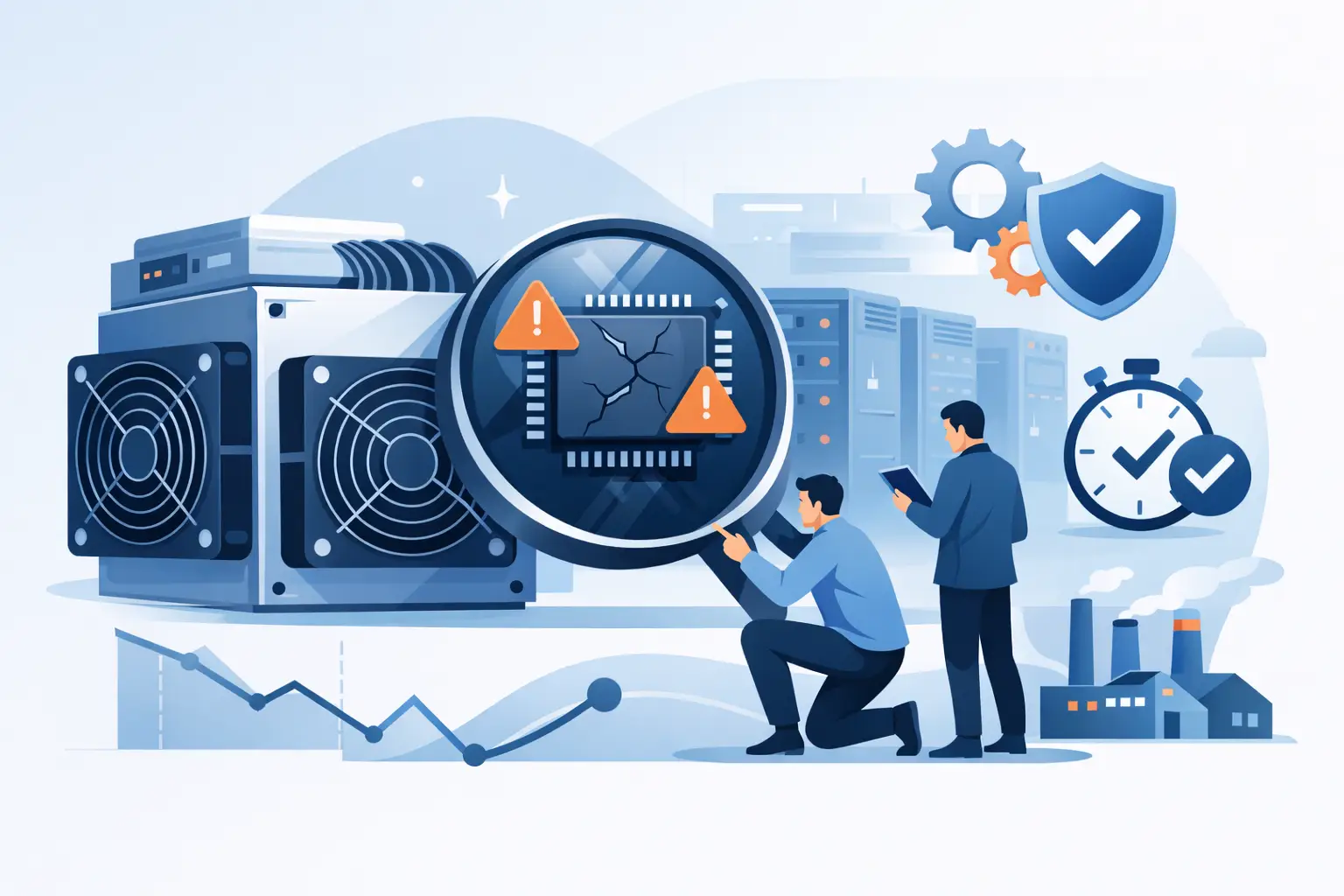
A miner does not have to be offline to be failing. A hashboard can lose chips one at a time, an inlet temperature can climb by a few degrees every afternoon, or a breaker can run close to its limit until one more machine starts. By the time the farm sees a red offline status, the revenue loss has already begun. ASIC reliability is the operating discipline that catches those conditions while they are still recoverable.
For a home miner, a failed unit is frustrating. For a hosting operation with thousands of machines, it is an SLA event, a customer conversation, a technician dispatch, and potentially a dispute over lost revenue. Reliability is not a hardware specification printed on a data sheet. It is the combined result of electrical discipline, thermal control, firmware behavior, maintenance execution, and how quickly the operation turns telemetry into action.
ASIC reliability starts below the fleet dashboard
Fleet hashrate is a useful business metric, but it hides the path to failure. A site can be producing close to plan while dozens of machines are degrading underneath it. The right operating view moves from site-level performance to container, rack, miner, hashboard, and finally chip-level behavior.
A declining hashrate reading tells an operator that something is wrong. Board-level telemetry tells them whether the issue is a missing board, unstable frequency, chip count loss, abnormal voltage behavior, or a thermal condition forcing the machine to protect itself. Those are different failures with different owners and different responses.
This distinction matters because blanket reboots waste time. Rebooting a miner with a temporary communication fault may restore it. Rebooting a machine with a weak hashboard, damaged connector, or failing fan can send it straight back into the same fault cycle. Worse, repeated restart loops can make an intermittent power or thermal issue harder to diagnose.
Reliable farms do not treat all offline miners as one queue. They separate communication loss, pool loss, low hashrate, board faults, overtemperature, fan faults, and power-related events. Each class needs its own escalation logic, maintenance workflow, and evidence trail.
Heat is a degradation engine, not just an alarm
Most operators have temperature alerts. Fewer use thermal data as a reliability signal before the alert threshold is reached. That gap is where avoidable failures live.
ASIC chips, voltage regulation components, fans, cables, and connectors all age faster under sustained heat. The issue is not only a single extreme event. Repeated periods of elevated inlet temperature, poor airflow, dust accumulation, or recirculated exhaust can push a machine into gradual degradation. A unit may continue hashing while consuming more power per terahash, accumulating hardware errors, or dropping individual chips under load.
The practical question is not simply, “Is the miner hot?” It is, “Is this miner behaving differently from comparable miners in the same environment?” If one row has higher board temperatures than adjacent rows under similar load, investigate airflow, containment, fan health, and cable routing. If one board consistently runs warmer than the other boards in the same chassis, the problem may be local to that board.
Temperature trends also need operating context. A rising temperature during an ambient heat spike may be expected. A rising temperature at stable ambient conditions is not. Good reliability monitoring pairs machine temperatures with site conditions, fan speed, hash rate, and power draw. That lets the team distinguish a hot day from a failing cooling path.
The trade-off between protection and production
Aggressive frequency settings can produce more short-term hashrate, but they reduce thermal and electrical margin. That may be acceptable for a controlled test group or during a high-revenue period with close supervision. It is a poor default for a remote site where technicians cannot reach the hardware quickly.
There is no universal frequency profile that maximizes profit for every fleet. The correct setting depends on hardware generation, ambient conditions, energy price, cooling architecture, power quality, and replacement capacity. Reliability-minded operations make that trade-off visible rather than pretending every machine should run at its maximum setting all year.
Electrical conditions decide whether faults stay isolated
A hashboard failure affects one miner. A breaker trip can take out a section of a container. This is why electrical visibility belongs in the same operating system as miner telemetry.
Breaker load must be tracked against real operating conditions, not nameplate assumptions. A circuit that appears safe during initial deployment can become risky after firmware changes, hotter weather, additional machines, or shifting voltage conditions. Load imbalance also creates avoidable exposure: one phase may be approaching its limit while another has unused headroom.
Live amperage monitoring gives electrical leads the ability to act before a trip. They can redistribute machines, reduce frequency on a targeted group, pause lower-priority units, or investigate abnormal consumption. Without that data, the first meaningful signal may be a dark section of the farm and a rush to restore service.
Power events also leave fingerprints. If several miners in one rack go offline together, the likely cause is different from a single machine dropping a board. Correlating outage timing with breaker conditions, power distribution zones, and device status prevents technicians from chasing individual miner faults when the real problem is upstream.
Pool integrity is part of ASIC reliability
A perfectly healthy miner that hashes to the wrong pool is not reliable production. Neither is a fleet whose workers silently fall back to an unauthorized endpoint after a configuration change.
Pool configuration deserves the same continuous validation as temperature and chip health. Operators need to know where every worker is pointed, whether the expected pool is accepting shares, whether hashrate distribution matches the intended routing policy, and whether worker names or wallet addresses have changed unexpectedly.
This is not only a security issue. It is an uptime and settlement issue. A pool outage, bad DNS resolution, invalid credentials, or misconfigured failover can turn a healthy fleet into a revenue leak. The most dangerous failures are quiet ones: machines remain online, power continues to be consumed, and the operation discovers the problem after a payout mismatch.
For hosting providers, clear pool and worker records also reduce customer disputes. When a client asks why their realized production differs from expected output, the answer must be based on timestamped machine behavior, not screenshots and assumptions.
Turn early warnings into maintenance work
Telemetry alone does not improve ASIC reliability. Someone has to own the next action.
An alert that lands in a chat channel without a ticket, priority, location, and response expectation is just noise with a timestamp. Large farms need automated maintenance workflows that create a task when a defined condition appears, route it to the right team, preserve diagnostic evidence, and record the outcome. The ticket should show whether the machine was rebooted, inspected, moved to repair, had a fan replaced, had a board swapped, or was returned to service after testing.
That history becomes operational intelligence. If a specific model repeatedly presents the same board fault after a certain runtime, stock the likely replacement part. If a container generates recurring fan failures, inspect its filtration and airflow rather than processing one ticket at a time. If the same breaker zone produces unexplained outages, investigate its electrical path before it causes a larger event.
Automation should not mean automatic rebooting of everything. Use remote actions for clear, reversible conditions such as a stuck service or temporary pool connection issue. Require human review when telemetry suggests a power anomaly, a repeated fault pattern, a potentially damaged board, or an elevated fire-risk condition. The objective is fewer truck rolls and faster recovery, not blind automation.
Measure reliability in operational terms
Uptime is necessary, but it is incomplete. A machine can be technically online while underperforming, unstable, or hashing to the wrong destination. A stronger scorecard tracks available hashrate against expected hashrate, recurring fault rate, mean time to acknowledge, mean time to repair, board failure patterns, thermal excursions, breaker load events, and the number of miners awaiting service.
The value of these measures is in comparison. A site with 98% uptime may look healthy until its peers achieve the same output with fewer board replacements, lower energy waste, and shorter repair cycles. Likewise, a site with more recorded incidents may actually be better managed if it detects and resolves minor degradation before it becomes a full outage.
MinersMe Cloud is built around this operating reality: one console that connects machine and chip diagnostics with electrical conditions, pool controls, maintenance tickets, and customer-facing records. The point is not to create another dashboard. It is to give the team enough evidence to make the right call before a small fault becomes a revenue event.
Reliability is earned in the hours nobody notices
The best maintenance day is not the day a technician heroically restores a dead row. It is the day a degrading board is identified, scheduled, and replaced before the customer sees a production drop. It is the day a breaker load trend triggers a controlled adjustment instead of an emergency shutdown.
Build the operating habit around those quiet interventions. Watch the trend, preserve the evidence, assign the work, and verify the result after the machine returns to production. That is how a fleet stays predictable when heat rises, hardware ages, and the next failure is already forming somewhere in the hall.
See it on your own fleet: create a free account, install the agent, or open the live demo — full fleet-to-chip monitoring is included in Pro at $0.40/miner.